
Method comparison: why chlorine fails for hydraulic fracturing flows
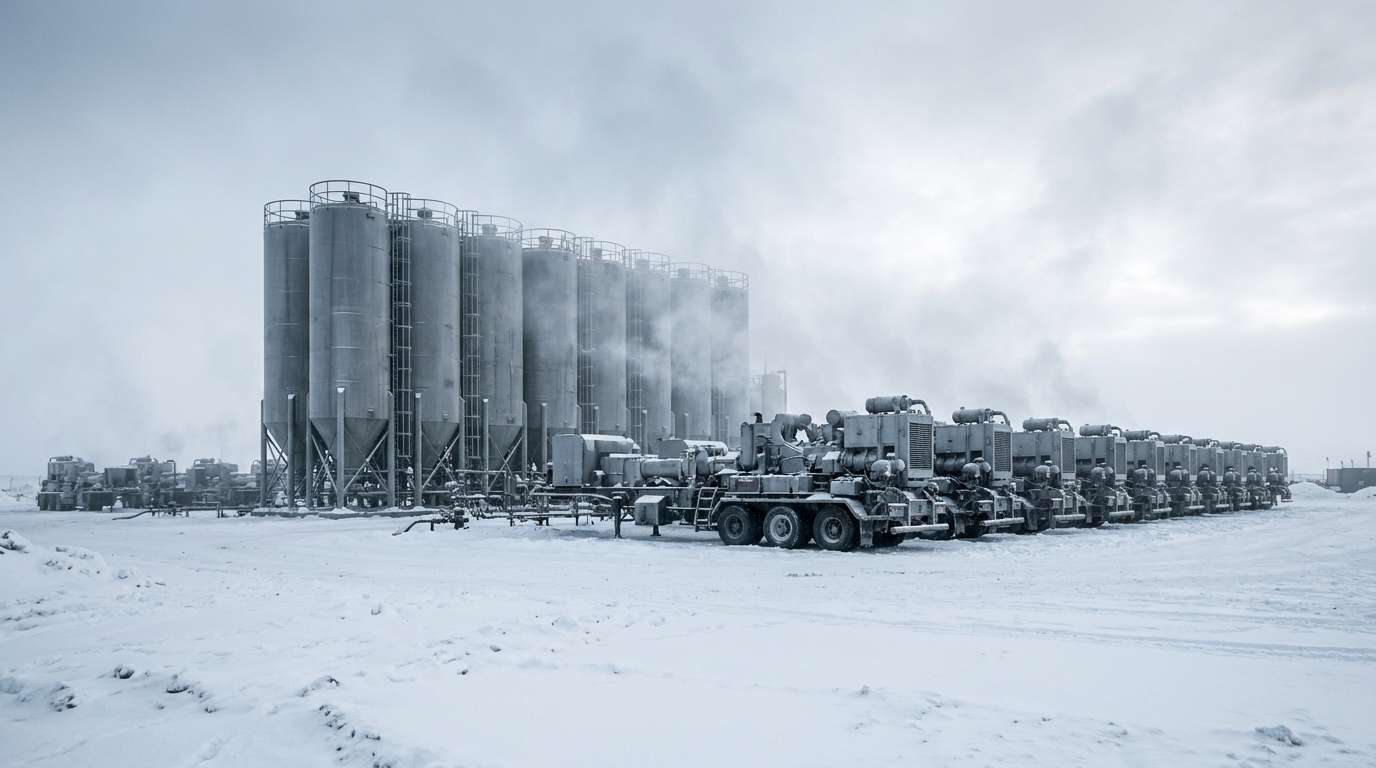
Hydraulic fracturing generates enormous volumes of flowback and produced water. The composition is challenging: high salinity, petroleum products, SRB, hydrogen sulfide, heavy metals, residual frac chemistry.
Treating such water for reservoir injection or discharge is the task where the classic chlorine scheme breaks down. Let's look at why.
What is in post-frac water
Flowback water after hydraulic fracturing typically contains:
- Salinity: up to 100–200 g/dm³ (the Bazhenov formation can show even higher values)
- Petroleum products (TPH): up to 10–50 mg/dm³
- Hydrogen sulfide: up to 400 mg/dm³ in the presence of an SRB infection
- Sulfate-reducing bacteria: 10² – 10⁵ cells/cm³
- Heavy metals: Fe, Mn, Ba, Sr, sometimes As and Cd
- Residual frac chemistry: gelling agents, surfactants, biocides
The standard task: treat this water for reuse in the waterflood (PMD) system or for disposal into an injection (absorption) well.
Why chlorine fails
High salinity. Chlorine reacts with dissolved ions and the effective concentration drops. To achieve disinfection, the dose has to be raised. This leads to reagent overconsumption and the formation of chlorinated organics.
Hydrogen sulfide. Chlorine oxidizes H2S, but not completely. Part of it converts to elemental sulfur, part to polysulfides. The result: clogged pipelines and residual corrosion.
Biofilms. SRB live in biofilms on pipeline walls. Chlorine works well against planktonic forms but penetrates biofilm poorly. A few weeks after chlorine treatment the SRB return.
Cold water. At facilities in Western Siberia and on the Yamal Peninsula, water temperature drops below 5 °C in winter. Chlorination efficiency then falls by 30–50%.
Frac reagents. Chlorine reacts with the organics in the frac chemistry. Some reaction products are toxic, some are insoluble, and some deposit on the equipment.
What is offered as an alternative
On-site hypochlorite. The same problems as chlorine, plus limited stability. It solves part of the logistics but not the chemistry.
UV disinfection.On water with TPH > 1 mg/dm³ it works poorly: the lamp quickly becomes coated with film and efficiency drops. On saline water there is the additional issue of deposits on the quartz sleeves.
Ozone. Oxidizes everything. But it is expensive, requires high-capacity power (up to 15 kWh/kg), and does not work at remote sites without a stable grid. On water containing bromides it forms bromates.
Industrial biocides. Glutaraldehyde, quaternary ammonium compounds, THPS. Effective against SRB, but expensive, do not remove hydrogen sulfide or petroleum products, and require neutralization before discharge.
Sodium ferrate. Oxidant + coagulant + disinfectant in a single process. Works in cold water, oxidizes hydrogen sulfide to sulfates completely, destroys biofilms, and precipitates heavy metals.
Comparison table
| Criterion | Chlorine | Hypochlorite | UV | Ozone | Ferrate |
|---|---|---|---|---|---|
| Disinfection | Yes | Yes | Yes | Yes | Yes |
| Oxidation of H2S to sulfates | Partial | Partial | No | Yes | Yes |
| Suppression of SRB in biofilms | Weak | Weak | No | Yes | Yes |
| Heavy-metal removal | No | No | No | Partial | Yes |
| Petroleum-product removal | Weak | Weak | No | Partial | Yes |
| Operation in cold water (0–5°C) | 30–50% reduction | 30–50% reduction | Normal | Normal | Normal |
| No chlorinated organics in output | No | No | Yes | Yes | Yes |
| Energy use, kWh/kg | Logistics | Logistics | 0.5–1.5 | 10–15 | 1 |
| On-site production | No | Possible | – | Yes | Yes |
| Hazardous-goods logistics | Yes | Yes | No | No | No |
Specific pilot data
Pilot at an oilfield of a major Russian VIOC (2024 trials):
| Parameter | Before | After | MPC |
|---|---|---|---|
| Suspended solids, mg/dm³ | 236 | 1.36 | 12.75 |
| Petroleum products, mg/dm³ | 0.78 | 0.053 | 0.1–0.3 |
| COD, mg/dm³ | 625 | 16 | 30 |
| BOD5, mg/dm³ | 221 | 3.0 | 3.0 |
| Hydrogen sulfide, mg/dm³ | 400 (initial) | 0.001 | – |
| Coliphages, PFU/100 cm³ | – | 0 | 100 |
OQ pilot in Oman (December 2025):
- TSS: −91%
- TPH: not detected
- Fe: −100%
- P: −86%
Where the catch is
Ferrate is not a silver bullet. During trials on a produced-water treatment unit (UPPDV) at PJSC Tatneft, certain operating modes showed exceedances in pH (up to 13), turbidity, suspended-solids concentration, and salinity after dosing.
This means one thing: the dose must be tuned to the specific effluent and integrated with the right polishing unit (settling tank, pH correction). On reservoir-pressure-maintenance system water, on domestic wastewater, and on frac flowback water, ferrate delivers results within MPC. On very saline demineralized water with a high alkaline reserve, additional measures are required.
That is why every project starts with laboratory testing on a specific sample.
What to do
If a chlorine or hypochlorite scheme is currently running at your field and you are spending money on additional biocides and corrosion inhibitors, it is worth evaluating the alternative.
Laboratory testing: 30 liters of your water → a protocol from an accredited laboratory with before-and-after results.