
Electroplating wastewater treatment with sodium ferrate
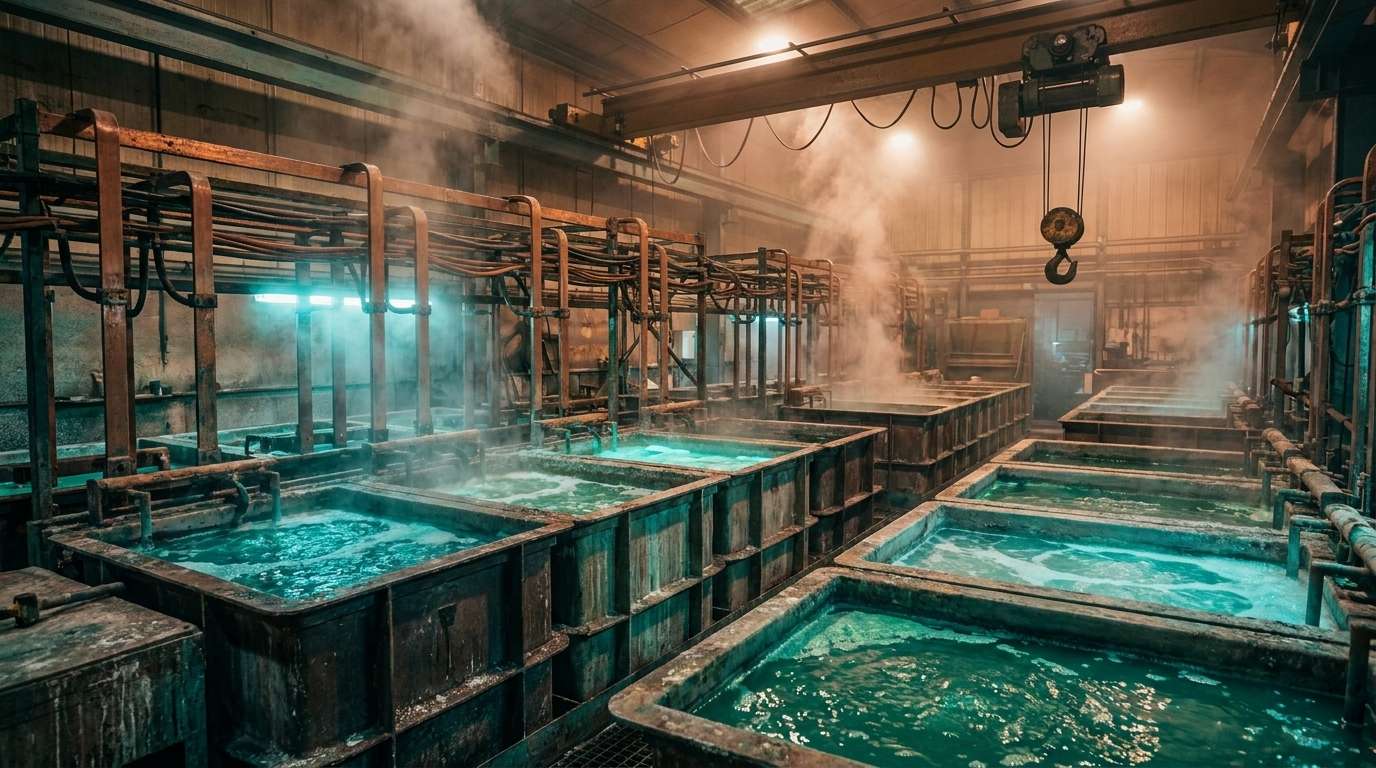
Electroplating is one of the most challenging processes in terms of wastewater. The effluent simultaneously contains: heavy metals (Cd, Pb, Cr, Ni, Cu, Zn), acids, alkalis, cyanides, chromates, surfactants, degreasing compounds, and residues of paint and varnish materials.
The standard treatment scheme is reagent-based: neutralization → reduction of hexavalent chromium → hydroxide precipitation → coagulation → flocculation → filtration. That means 4–5 reagents and just as many dosing units. At small plants the scheme does not pay off; at medium-sized ones it operates at the edge of the standards.
What sodium ferrate achieves with heavy metals
During trials at the Krasny Bor landfill (one of the largest industrial waste disposal sites in the Northwest Region):
- Cadmium: reduced 2,000-fold
- Lead: reduced 100-fold
- Organics brought down to levels meeting the MPC (maximum permissible concentration) for domestic wastewater
Laboratory tests on toxic water containing Cd and Pb (measured on a TA-lab potentiostat with an amalgamated electrode):
| Parameter | Influent | After treatment |
|---|---|---|
| Cd, mg/dm³ | 2.5 | 0.057 |
| Pb, mg/dm³ | 0.096 | 0.00 |
Cadmium was reduced more than 40-fold, and lead down to a level below the method's detection limit.
How it works chemically
Sodium ferrate (Na2FeO4) is an oxidizer with a redox potential of +2.2 V. As it decomposes in water it passes through several stages: Fe(VI) → Fe(V) → Fe(IV) → Fe(III). At the final stage, iron hydroxide nanoparticles Fe(OH)3 with a very high specific surface area are formed.
These nanoparticles capture heavy metals through two mechanisms: adsorption on the surface and incorporation into the crystal lattice of the oxide. The second mechanism is important — it gives the sludge stability. Heavy metals are not leached back out when the pH changes, as often happens with hydroxide precipitation.
Compared with classic coagulants (iron sulfate, iron chloride, aluminum sulfate), the volume of sludge produced with ferrate is significantly smaller — this is the difference between disposing of several tonnes of sludge per month and just hundreds of kilograms.
What else ferrate handles
Chromium(VI). Chromates are reduced and precipitated as chromium(III) hydroxide. Without a separate sodium bisulfite step.
Cyanides. Oxidized to cyanates and further to carbon dioxide and nitrogen. Without chlorination.
Organics from degreasing baths. Ferrate breaks down surfactants and organic complexing agents that often interfere with metal precipitation in the classic scheme.
Microbiology. If the wastewater contains organics and warm water, it also contains bacteria. Ferrate handles this task along the way, without a separate disinfection step.
A product range matched to volumes
For an electroplating shop, the Ferrator-160 or Ferrator-1000 is usually suitable, depending on the wastewater volume:
| Model | Output | Industrial wastewater treatment |
|---|---|---|
| Ferrator-160 | 160 g ferrate/day | up to 4 m³/day |
| Ferrator-1000 | 1 kg ferrate/day | up to 25 m³/day |
| Ferrator-10000 | 10 kg ferrate/day | up to 250 m³/day |
The unit is automated: alkali feed, concentration control, and dosing matched to the current load. Energy consumption is 1 kWh per 1 kg of finished reagent. Electrode replacement takes 2 minutes once every 4 days. Operated by regular staff, with no special clearances.
How to verify the technology: two options
Electroplating wastewater varies greatly in composition, even within a single plant. A chromium-plating bath and a nickel-plating bath produce completely different chemistry. That is why verification is carried out on real samples.
Option 1. Send us 30 liters of your most contaminated effluent. We perform sodium ferrate treatment in the laboratory and return an accredited laboratory test report with before-and-after readings. Turnaround: 3 weeks.
Option 2. We send you a sample of the finished reagent (sodium ferrate solution). Your laboratory runs the tests according to its own protocol. The turnaround depends on your laboratory.
With no obligation to purchase equipment afterward.
What you receive from the test
- An accredited laboratory test report with before-and-after readings
- A dosage selected for your specific effluent
- A calculation of daily reagent consumption
- A total cost of ownership calculation accounting for your current scheme and the Ferrator
- Payback period